
This web page contains the logs of a two week trip with S/Y Thetis in the Greek Aegean from Glyfada near Athens to the island of Samos, via the Cyclades (Kea, Kythnos, Syros, Rhinia, Donousa), and the Dodechanese (Patmos, Agathonisi). The logs are illustrated with maps and photographs, and also include some historical and geographical descriptions of the places visited as well as several links to other related web sites.
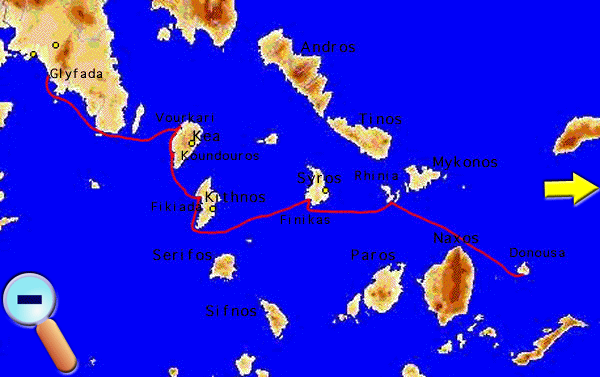
Thursday June 11, 1998 Day 1
The big day came! Rohalio (the man who maintains both Thetis and Faneromeni) has done everything I had asked him to do and the boat is sparkling clean. The only thing missing is that Mr. Petros, the electrician, did not show up to rewire the wind generator.
I took the boat papers to the Limenarchio (Coast Guard) for the inevitable apoplous (permission to leave port). The officer there looked at me, knowingly, and asked:
— Your charterer is Mrs. Swift?
(That is my wife’s maiden name, she appears as the charterer because for bureaucratic reasons the boat must be chartered to a non-Greek citizen for a number of days every year).
— Yes.
— You are the owner and skipper?
— Yes.
— No other passengers?
— No.
— Just the two of you (knowing smile)?
— Yes
— Have a wonderful trip (as he stamps the documents and winks at me).
Amazingly enough, we cast off at 1130, a completely new record for early departure from Glyfada, and we headed for Kea (Tzia) where we were to link up tomorrow with my brother Byron, his wife Ivi, Rozina, my brother’s Nikos girlfriend, and her dog Naxos. The wind was from the SE 15-20 knots, dead against us. Not even a prayer of a chance to move under sails. It looked like motoring all the way. Since I know that Byron’s cove, Koundouros, is not protected from southern winds, we headed for Vourkari. The autopilot was not receiving a signal from the GPS and could not be set in the track mode. As we were approaching Kea, we managed to open the genoa and motor-sail the last 8 miles.
We arrived at Vourkari [37° 40' N 24° 19.5' E], Kea at 1650 having covered 32.1 M. Having untangled the chain during the passage (chains left unused over long periods have a way of fouling) we anchored without any complications. After inflating the zodiac we started the new Yamaha Malta outboard. It worked very well. The only problem was that the new cover I had made last winter for the outboard fitted the old Evinrude and not the new Yamaha. But it was still usable. Also, the cover for the passarella (gang-plank) fitted only one end. The covers were a mixed success. The wind generator also had a problem: although its LED lit up, indicating current, it did not charge the batteries.
We made supper on board and slept soundly our first night this year on Thetis.
Friday June 12, 1998 Day 2
First morning on Thetis. I slept beautifully. Nothing beats sleeping on a boat, especially one so familiar as dear Thetis. I woke up at 8:30 and made coffee while Alice was still asleep recovering from her jet lag. The smell of fresh coffee woke her up. While she stowed our clothes I put up the tent. Now we had room to move in the main cabin.
After a brisk walk to Agios Nikolaos, where we bought fresh bread and cherries, we departed at 1145 for Koundouros. We got there at 1330, motoring all the way. The wind was still 15-20 knots SE and the surf was too uncomfortable, so we motored back north to the nearby Pises [37° 36' N 24° 16.4' E] cove where we anchored at 1405 (10.2 M).
We spent our time rearranging items and tidying up. The main cabin is now nice and clean. We went swimming in the clear waters, had lunch, and took a restorative siesta. At around 6:15 PM, as we were getting ready to raise our anchor, Byron and the ladies arrived in his truck, having seen us from the road on their way from the Agios Nikolaos ferry to Koundouros. We shouted at them that we would first go to Koundouros and if still not safe we would head back to Vourkari.
We left Pises at 1830. Koundouros, once again, I was not comfortable as the wind was an even stronger 20-30 S, so we turned around and headed for Vourkari. We were able to actually sail, for the first time this year, with the genoa. It was a fast 5.45 M sail that got us in Vourkari [37° 40' N 24° 19.5' E] at 1930. There were, being Friday evening, lots of boats, mostly motor cruisers. We anchored at 12 m depth without any problems letting out 50 m of chain.
We tried to call Byron using the Autolink but instead of getting through we got a “PIN Error” indication. I tried dialing Niko’s number in Voula and his mobile phone and had no difficulty. Byron’s number, however, would not go through. I went ashore and called him from a card phone and told him that we would try to come to Koundouros tomorrow.
We had a nice, if expensive, ouzo ashore with grilled octopus for meze (tasty snack). The wind was gusting to 30 knots but the water was calm. Alice cooked rice with tuna and made a salad. We ate dinner in the cockpit under the moon which was just 2 days past full. It felt wonderful to be back on Thetis.
Saturday June 13, 1998 Day 3
I fixed some of the tent cords that were frayed by either replacing them or by burning their ends. I then went for a 50 minute brisk walk. I was feeling fine and the work on board did not seem to tire me but I wanted to exercise and build my strength to the point that I would feel comfortable to sail by myself.
I called Byron from a card phone and he said that the wind was dying out and it was getting calmer at Koundouros. He would come with his inflatable and help us take a cavos (shore line) to the rocks. I also called Hellas Radio, the operators of the Autolink network, and they promised to look into my problem. Back on board, we started preparing for departure. Unfortunately a motor cruiser had come late last night and anchored extremely close to us and had also crossed our anchor chain. Now there was no one on board to help. It took a lot of maneuvering and the use of our powerful windlass to bring our anchor right on their chain and then to raise both of them. As their chain was very heavy, out windlass tripped its circuit breaker (installed last winter to replace a conventional fuse) several times, but eventually the chain came up and we were able to tie a short line to hold it in place while we lowered our own anchor and disengaged it from the chain.
We departed Vourkari at 1018. The wind, despite the Navtex forecast that called for a brisk northwester, was 10-12 knots S so we had to motor again. During the passage I hailed Hellas Radio on the VHF. They had looked at their end and confirmed that both my account and the PIN number were in order, they suggested that there may be a problem with the nonvolatile memory of my unit and the only person that would know what to do is Mr. Vasiliades, who had also installed it on Thetis. Unfortunately he would not be in the office until Monday but they patched me to his mobile phone. He did not answer but I left him voice mail. I also serviced, primed, and started the watermaker which worked well. That was a relief because we would not have a water shortage problem now that we were heading to the water-deprived Cyclades.
We anchored in Koundouros [37° 34.8' N 24° 16.7' E] after 7.7 M at 1110. Byron, with whom we had intermittent contact via channel 72 on the VHF, was there with his large inflatable and took our long 80 m line ashore and secured it with a loop of chain (I use this to prevent the line being frayed) to a large rock on the NW inlet which provides some protection from the SE swell.
With Thetis secured, we all drove in Byron’s truck up to his house on the hill of Katevati, overlooking the cove, where we were greeted by the ladies and Naxos. We had a leisurely lunch with ouzo and snacks. After lunch, almost 4 PM, Byron, Alice, and I went with Byron’s inflatable for a swim to the cove just north of the lighthouse at the southernmost tip of the island. The water was crystal clear and translucent. By that time the wind had almost died out.
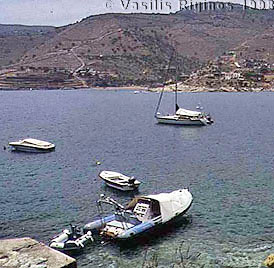
Back on Thetis, I installed the new recording barometer/thermometer that Alice had given me for Christmas. Later Byron came and drove us back to his house where we were joined by our mutual friends Pascal and Thanasis Yanoukos and their lovely daughter Emily for dinner. We have known Emily, who is a couple of years younger than our own daughter Cynthia and is now studying art history in Paris, since she was a toddler. It is nice to see what a pleasant young lady she has become. The dinner was bountiful: salad, grilled fish, stuffed tomatoes and peppers, cheese… All drowned with abundant white wine.
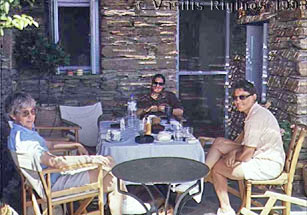
As is common in Greek dinners, time goes by very quickly; by the time we were back aboard it was well past 1:00 AM. The wind had finally shifted to the West and was raising a considerable swell but we were comfortably securely tucked in our little inlet.
Sunday June 14, 1998 Day 4
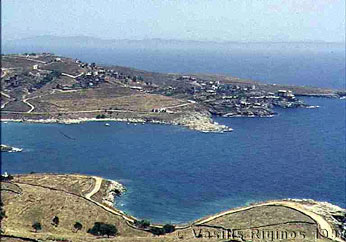
The wind was now coming from the WNW at about 10 knots. The barometer had risen somewhat since last night. We went for a nice walk.
After the walk I hailed Byron on the VHF, as we had arranged, but there was no answer until past 11:00 when with a groggy voice he said that they had just woken up. Around 1:00 PM Thanasis hailed us to warn us that they would be coming for a swim in about ¼ of an hour. Around 2:15 Byron, Thanasis, and Emily did come, just as we were getting ready to sail for Kithnos. The ladies all went to visit our childhood friend Evi who was staying in a nearby hotel. We were also joined by Byron’s neighbor and friend John, who has a company that represent the geographical satellite IOS in Greece. We all had an ouzo with a rice salad under the tent.
After our guests left, we raised our anchor and departed Koundouros at 1518. We had an easy motor-sail for the 11.0 M to Fikiada [37° 24.7' N 24° 23' E], Kithnos where we arrived at 1725. The wind was 5-12 knots from the WSW.
There were several boats in the anchorage but we anchored without any problems. Later we had ouzo and a vegetable soup for supper.
Monday June 15, 1998 Day 5
We left at 0915 heading south for Syros. The wind was a slight 8-10 knots from WSW and we had to motor-sail. We used both sails, the main raised for the first time this year. Even motor-sailing, I love it! After Cape Ay Dimitrios at the southern tip of Kithnos we headed more to the East (075° M) towards Finikas. The wind now was slightly stronger, 10-18 knots, and at last we were able to turn off the motor and sail free. This was a wonderful moment for me. On the way I spoke with Mr. Vasiliades of Hellas Radio. It turns out the Autolink problem was not real but due to an operator error (mine). The unit has a memory where one can store frequently called numbers. I had stored Byron’s number there. But, it also stores together with the number, the PIN code entered at that time. I must have made a mistake entering that PIN. So every time I recalled Byron’s number I also, without realizing, must had been recalling the wrong PIN, hence the error. One learns every day.
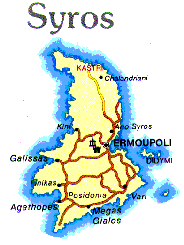
We reached Finikas [37° 23.5' N 24° 52.5' E], Syros at 1510 crossing 30.7 M. The island of Syros or Siros is the capital of the Cyclades. It is not a very tall island and its area is 86 km² and it has about 35,000 inhabitants. The name Syros has been used since antiquity and it is probably of Phoenician origin. There was a sizable Cycladic settlement (Bronze age) over the NE coast and the island that is mentioned in the Odyssey as the home of the swineherd Eumaios. Pythagoras’ teacher Pherekydes was from here. In the Middle Ages Syros was dominated by the Venetians. Today there is a sizable Catholic population, remnant of that period. In later times many well known European visitors such as Byron, Nerval, Chateubriand, and Melville started their Eastern Mediterranean tour from here. After the Greek War of Independence of 1821, Syros became the maritime, commercial, and cultural center of the Aegean and a place of refuge. Young Nikos Kazantzakis went to school in Syros. Today there are many neoclassical mansions in Ermoupolis and Piskopio as well as in the aristocratic resort of Della Grazia near Finikas.
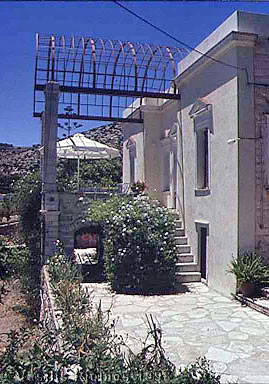
After anchoring arodo (offshore) without any problems we went ashore and called our friends Yankos and Sue Krinos. Yankos and I had attended the same school in Greece: Athens College. Several alumni from that school live in the Washington, D.C. area and we have formed a little circle. Now the Krinos’ have moved to Florida so we do not see them as often as we would like. Yankos comes from an old Syros family and owns a beautiful neoclassical villa in the Piskopio region, overlooking Ermoupolis, which he and Sue have lovingly and painstakingly restored to its former glory. We would get together later.
The temperature was a warm 28° C (82.4° F) but it felt fine under the tent. We fell asleep without even swimming. In the evening we went ashore and called our daughters in the US and Alice’s mother. We then took a long walk. Everything was fine and lovely but we felt depressed with the memory of our departed friend Giorgos Orologas. Finikas seems not the same without him.
Later we were met with Yankos and Sue who drove us to the west side of the island to see the gorgeous sunset and then to their villa for dinner. By the time we took a taxi back to Finikas it was past midnight.
Tuesday June 16, 1998 Day 6
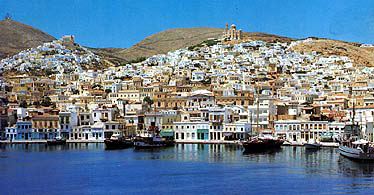
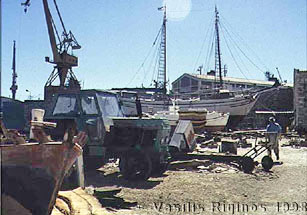
We took the 9:30 bus to Ermoupolis, the capital of Syros, where we wanted to do a number of shopping errands. I needed several items from a chandler to replenish the docking lines which always get lost over the winter, and electric cables to install the new NMEA to SeaTalk converter and audio alarm buzzer, etc. We also had to send the signed charter papers back to Athens. We were, by enlarge, successful except I could not find a wood shop to drill some holes to the panel where the buzzer was to go, so I bought a new manual drill to replace the electric one which was drowned due to the Lavrio shipyard’s negligence. Looking for the shop we went through the famous Syros shipyards.
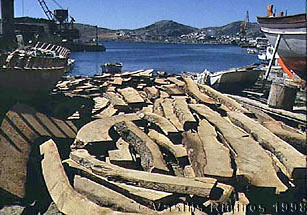
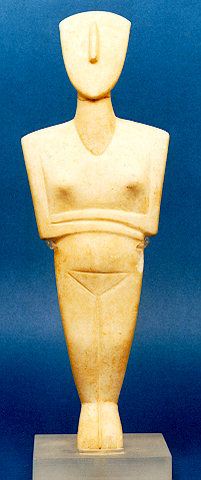
After the errands we went to the little museum next to the Demarchio (Town hall). They have a small collection of Cycladic items from Syros, Amorgos, Andros, and other islands. Some were very nice, some lovely marble vessels, two nice Roman heads. The exhibits unfortunately, were very badly labeled.
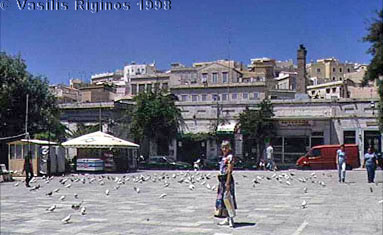
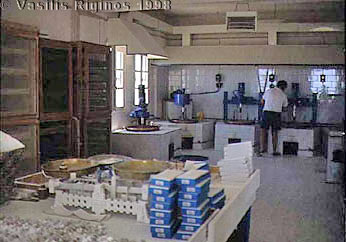
While looking for the stop of the bus to take us back to Finikas we stumbled upon the Krinos. They drove us to a λουκούμια (loukoumia - Turkish delight) “factory,” in reality a small building with several men and women, mostly related to each other, chattily making loukoumia and χαλβαδόπιτες (chalvadopites - a kind of taffy cake). Syros is famous in all of Greece for these sweets. We had to sample all the products of which they were very proud. The place was spotless, and everything did taste delicious, especially the still warm chalvadopites. We bought several boxes of both loukoumia and chalvadopites.
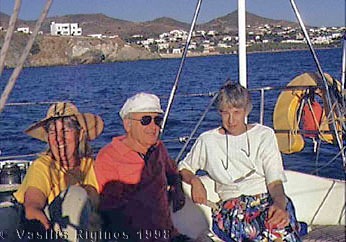
We then went to the Krinos house where bathing gear and some foodstuff was packed and then we all drove to Finikas for a picnic excursion with Thetis. With both Sue and Yankos aboard, this being their first time on a sailboat in Syros, we raised the anchor and motored past Cape Velastasi to a little cove which despite the brisk 20-25 knot wind, was somewhat sheltered. Alice prepared lunch and we ate with great gusto under the tent at the fashionable Greek hour of 4:00 PM. We then talked and swam for a while and then slowly motored back to Finikas.
By the time Yankos and Sue left it was past 8:00 PM but I still had to attend to refueling. I siphoned Diesel fuel from the two spare jerry cans to the tank and then wheeled the cans to the gas station at the outskirts of town and refilled them with 44 liters. In the mean time Alice went grocery shopping to the little store that was ready to close for the day. By 10:00 PM we were back on-board and the jerry cans and groceries were stowed away. Alice cooked a delicious potato and carrot soup. We have definitely adapted to Greek time.
Wednesday June 17, 1998 Day 7
Finikas at 0805 heading for the nearby island of Rhinia, one of my favorite anchorages, deserted and well protected. After rounding Cape Βελαστάσι (Velastasi), the wind increased to 25 knots and we raised the main, on its second reef. One of the main’s slides (made of plastic) broke and we improvised by tying the sail with a rope around the mast. As the wind freshened we reduced the genoa and sailed very nicely. We experienced strong gusts, reaching 48 knots, and reduced the genoa even more. We arrived at the south cove of Rhinia [37° 23' N 25° 14.4' E] at 1220 crossing 18.7 M.
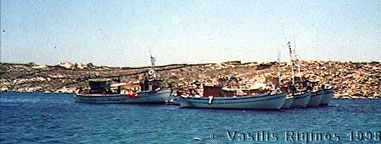
The wind was very strong and despite the protected cove there were many small waves. It was too windy to put up the tent and we had to eat our lunch inside the cabin. There were many fishing boats anchored here for the day. They go fishing at night. I have never seen such a number of them here before.
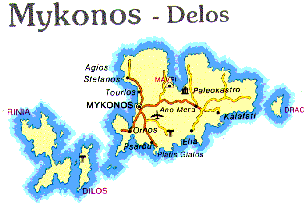
Rhinia or Rhenea also known as Greater Delos is an almost uninhabited island just west of Delos from which it is separated by a narrow channel. It’s history is closely associated with that of Delos. According to the Greek mythology Delos was a floating island where Leto, after being impregnated by Zeus and refused by every land because of the wrath of Hera, gave birth to Apollo and Artemis. Apollo chained the island to the floor of the Aegean sea. In historical times the powerful tyrant of Samos, Polykrates, donated the island of Rhinia to the sanctuary of Apollo in Delos and attached a chain across the channel. The tyrant of Athens, Peisistratos, undertook to “purify” the sacred island of Delos by digging up the bones from burials there and conveying them to Rhinia for reburial. After the Persian Wars (490, 480-79 BC), the Delian League, the Athenian-led naval alliance against Persian expansion, was formed in 477 on the island of Delos. During the fifth century Delos and Rhinia were controlled by the Athenians who continued to guard the sanctity of Delos by forbiding both births and deaths on the island. Pregnant women and old people were taken across the channel to Rhinia to give birth or die. Many graves have been excavated and the finds are exhibited at the Museum in Mykonos. Today only a few people from Mykonos keep some animals on Rhinia and during the summer months stay in isolated cottages.
In the afternoon, I installed the new NMEA/SeaTalk bridge and the alarm buzzer. The alarm does activate from the depth sounder but no SeaTalk messages are delivered via the NMEA bus.
At night Alice cooked a wonderful dinner of pasta with mushroom and pepper sauce. There were strong gusts through the night.
Thursday June 18, 1998 Day 8

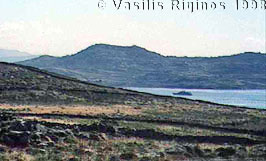
In the morning the sea was fairly calm. We launched the zodiac and went ashore for a long walk. We passed several cottages. Delos was clearly visible across the channel.
There were many seagulls near the fishing boats which had returned from their fishing and were cleaning their nets.
In the late morning two other sailboats came and anchored near us. In the evening we went ashore again, this time to cut thyme for cooking. The Navtex was predicting gales for the Ikarian and Karpathos Seas but only force 6 for the central and SE Aegean. We were not sure whether to leave or not tomorrow.
We had dinner of curried rice with chick peas that we had purchased in Turkey last year, and canned turkey, onions, and garlic.
Friday June 19, 1998 Day 9
I got up at 4:30 and since the latest Navtex report, which was received overnight, did not show any further deterioration but still predicted a gale for tomorrow, we decided to leave for Donousa. Just to play it safe I installed the storm jib and set the main on its 3rd reef. We left Rhinia at 0525. The wind was not very strong and we had to motor-sail for the first 5 miles since we were under-canvassed. As the day progressed, however, the wind did pick up, coming from the NNE at over 25 knots and gusting to 38. We had a nice sail with large waves at our quarter. During the passage the new fresh water pressure pump started spontaneously to pump. The water pressure built up on the hoses and started leaking from the clamps. By the time we became aware of the problem a lot of water from the fresh water tank had been pumped to the bilges. About 6 miles form Donousa the wind weakened and we had to motor-sail again since we were too close to change the sail configuration.
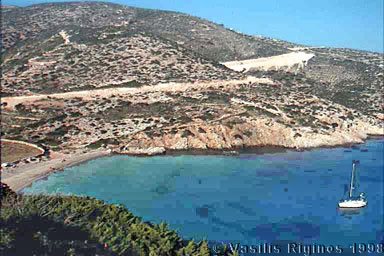
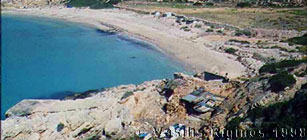
We arrived at the Dendro [37° 05.7' N 25° 48.2' E] or Kethros or Kentros cove (all these names are in use) on the island of Donousa at 1150, distance traveled 30.7 M. There were very strong gusts but no waves. We anchored by setting the primary anchor right next to the shipwreck and letting out 50 m of chain and then setting the secondary anchor 30° to the east with 20 m chain and 60 m rope. This cove is much better protected from the meltemi than the exposed little harbor at Stavros, just west of the cove. There is a lovely sand beach here populated by several tents with middle aged nudists.
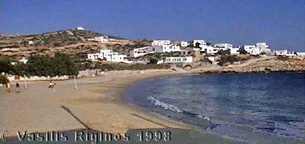
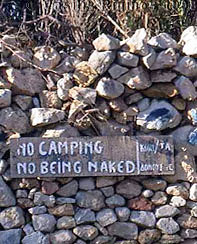
Donousa has a 480 m peak and altogether 110 inhabitants living in 4 villages: Stavros, Panagia, Mersini, and Mearia. It has a grade school and a middle school with 6 students! During the summer in Stavros there are 3 restaurants, a rather sophisticated bakery, and at least 2 grocery stores. The beach at Stavros is also very attractive but, unlike in Kentros, nudism and camping are not encouraged.
I addressed myself to the fresh water pump problem. It would only pump intermittently even while its motor kept running. After I opened the pump, it would run for a while and stop again. Eventually it stopped working all together. Our fresh water tank was now low. The Autolink did not work from here. The Navtex was now issuing gale warnings.
Later in evening we launched the zodiac, went ashore, and walked to the little Stavros hamlet, one cove to the west, and tried to call Mr. Petros, the electrician in Athens, to ask him to send us another pump, but he was not answering his phone. I called Rozina and asked her to please find him and give him a message to locate a replacement pump and that I would call back tomorrow. We then went to same restaurant at the Eastern end of the beach that Corinna and I had a good meal 2 years ago. They had run out of fish but nevertheless we had a good supper. By the time we walked back to Dendro it was dark. We had a lot of difficulty launching the zodiac against the considerable surf. While doing so, a large wave totally drenched us. Finally on our third attempt we were launched and got back on Thetis and into dry clothes. We fell asleep completely exhausted.
Saturday June 20, 1998 Day 10
Still gale warnings were coming over the Navtex, and the sea was indeed very rough outside of the cove. In the cove there was substantial surf and the wind was at 25 knots with gusts but we were safe and the anchors were holding.
I tried to trouble shoot the problem with the SeaTalk data bus. All cable connections were good and not lossy. The link was continuous from the wind instrument, to the tri-data, to the autopilot, to the radar, and to the NMEA/SeaTalk bridge. But, when the radar was connected to the autopilot, the wind instrument did not get data from the tri-data and it could not operate in the True mode. Either way, the radar did not get any data from the other instruments. I disconnected the bridge, thus restoring the setup that had worked flawlessly for two years, to no avail. I had run out of ideas.
We also had some difficulties with the watermaker which, now that we were low on fresh water, had become vital. It manifested the same problem that it had last year. It starts working properly, producing fresh water, but after some time the salinity sensor detects salty water and deactivates the flow to the tank. However, when I tested the actual water out of the membrane it was not salty. I “fixed” this problem by overriding the sensor’s input to the solenoid. Other than that the watermaker was working and we filled empty water bottles since we had no means of pumping the water out of the tank because the manual pump did not work either. This pump was not on my checklist (now it is) and so I did not test it before leaving Glyfada. It was working last year.
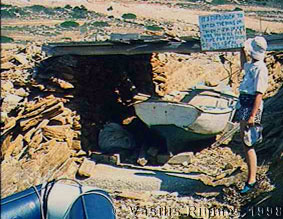
Later in the morning we walked to Stavros and called Rozina and Mr. Petros. He will give a new pump to Rozina and she will send it to us in Patmos. We then did some shopping and walked back. We had found a tiny sheltered inlet, large enough for the zodiac, on the east of the Dendro beach where we had left it. Now we had no problems with the surf. I went snorkeling and checked the anchors. Both were well dug in the sand.
In the late afternoon the large 55 ft Nicholson sloop Andria came into the cove. She had both her sails torn into ribbons and her boom was broken into two. There were 3 men on-board one of them Greek. They were sailing when the gale caught up with them, their roller reefing failed, and their genoa was ripped and tangled with the main. They were in a state of shock.
The wind increased and howled all night with strong gusts while changing direction across a 40° band.
Sunday June 21, 1998 Day 11
The Navtex was still issuing gale warnings. The wind here was at 25 knots with higher gusts but not as bad as last night.
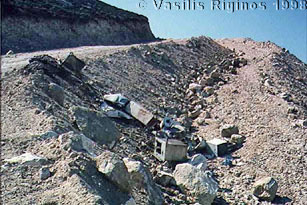
We took a two hour walk. Donousa is a beautiful island but some of its beauty is spoiled by a new dirt road that has left an ugly scar. To add insult to injury, while we were walking, a truck came and dumped a rusty washing machine, a water heater, and an industrial stove on the side of the road. When will people learn how to respect this beautiful world of ours and stop polluting it?
The wind continued. Our friends from the Andria were very concerned about the forecast and asked us about the latest weather report. We are all marooned by the gale but if one has to be marooned one cannot ask for a lovelier spot. The sand at the Dendro or Kentro cove was fine and clean. The nudists did not bother us and did not dirty the beach nor did they make any noise. The wind and surf were fierce. One cannot spend more than 5 minutes in the cockpit. Lying on the beach was not too comfortable either, because one was sandblasted.
We walked to Stavros and called Rozina. She has the pump and will be mailing it today, Post Restante, to Patmos via express mail since there is no courier service to Patmos. We were hoping that we will get it since washing ourselves has become a problem. We could only use water from the sun shower and from bottles. We ran the water maker, filled bottles, and also filled the sun shower from the bottles.
Alice made a “Chinese” dish using the canned water chestnuts that I had purchased thinking that they were artichokes!
During the night the wind once again became fierce. We had to take the zodiac on board and lash it down because the wind was lifting it, motor and all.
Monday June 22, 1998 Day 12
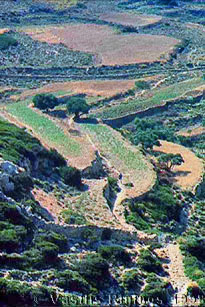
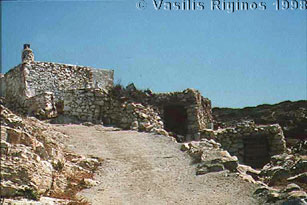
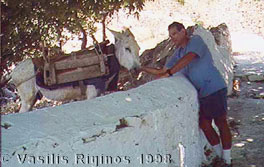
We are still on Donousa but the wind is down today although the Navtex is still issuing gale warnings. We took a long walk to the village of Mersini. It is a very pleasant walk through terraced valleys with lots of small donkeys. The actual village is very primitive but it has a large solar cell installation which was built by European Union funds 10 years ago. Now it was no longer working because of lack of maintenance.
|
|
|
|
After we returned and had some lunch I took the zodiac for a ride east of our cove and explored the nice inlets. I was very pleased with the new outboard.
In the late afternoon we walked to Stavros for an ouzo and some shopping. By now we seem to know everyone. We carried back to Thetis as many bottles of spring water as we could. We are feeling the fresh water shortage and we are washing all the dishes and pots and pans with sea water. At least we had the water maker but we had to run the motor while we are operating it since the wind generator was not working either.
By nightfall the weather had improved a lot. The highest gust of the wind was below 15 knots! We will be leaving for Patmos tomorrow.
Tuesday June 23, 1998 Day 13
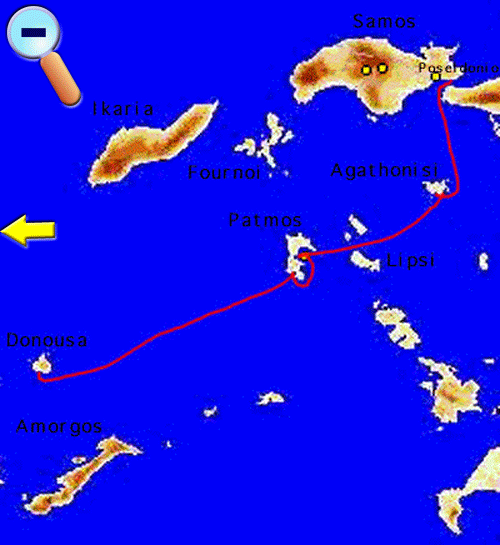
We were woken up by the alarm which we had set for 5:00 AM so that we could leave for Patmos early while the sea would be calmer. During the night a fishing boat came and anchored right over our secondary anchor so that we could not retrieve it with the windlass but had to get it by hand with the zodiac. The wind this morning was very light from NNW. The deck light burned. We managed to leave Donousa at 0630.
We were able to sail with the main (no reefs) and the full genoa for about 20 miles with winds of 10-14 knots NNW. Then the wind died out and we had to motor-sail. We arrived in the Stavros [37° 17.5' N 26° 32.6' E] Bay, in Patmos at 1318 after 33.8 M. We looked around the bay, and finally we anchored in Psili Ammos [37° 17.3' N 26° 33.2' E] (thin sand), a delightful beach. We had lunch and a swim.
We left Psili Ammos at 1435 and motored the 6.79 M around the island to Skala [37° 19.4' N 26° 32.9' E] where we arrived at 1605. While we were running the motor, we turned on the water maker and we filled the sun shower bag and several bottles with fresh water. In Skala we moored stern-to without any problems. They have changed the location for yachts to the new quay, a little distance north of the old one. By the time all our lines were in order and we had deployed the passarella I was exhausted. This is the first time since the beginning of our trip that I felt physically weak.
We were amazed by the increased number of motor scooters since last summer. We filled our fresh water tanks replenishing the water that was pumped into the bilges by the faulty pump, but until we get the new pump we cannot use it. We gave our dirty clothes to a new laundry just across from the quay. We then walked to the old harbor and had a very welcomed cold beer. At a table across from us sat a very odd couple: the most disreputable looking young monk, with a very dirty gown and very shifty eyes, and a fat young woman (his sister as they looked remarkably alike) with very large thighs and feet (she had taken off her shoes). They were having a drink, she staring into space, while he was talking on his cellular phone.
Finally we were able to have a warm shower which seemed a great luxury after doing without showers for the past few days. Clean and refreshed we went out to dinner. We had some wonderfully fresh μπαρμπούνια (barbounia - red mullets) at the old reliable Pyrofani restaurant. The night was hot and there was no wind at all!
Wednesday June 24, 1998 Day 14
First thing in the morning we went to the post office to see if the pump had arrived. No, there was no express package for us either in my name or in the name of Thetis. After some argument, we decided to wait for the package until tomorrow rather than have it forwarded to Samos.
With plenty of time on our hands, we went shopping: 2 cases of spring water, wonderful fresh bread, fruits, French mustard, etc. We had a nice lunch under our tent.
Later, while Alice was resting, I motored with the zodiac to a small cove, north of the harbor and had a swim and washed the zodiac. One of the great features of Skala for a yachtsman is that it is one of the few harbors in the Greek Aegean where one can get fuel directly from a hose. Alas, it was not possible to do so today. The small dock at the pump station was occupied by a small freighter which was not to move for at least one more day. So we were back to the familiar jerry can routine. I siphoned fuel from the spare cans, then transported them with the zodiac to the station, filled them with 33.5 L, and took them back to be stowed in Thetis’ sail locker.
At least we had plenty of hot water (too hot) from the sun shower for the much needed showers after the Diesel routine. We had a pleasant dinner at a little grill restaurant off the main inner road of chicken, chicken donner, and sword fish kebab washed down with plenty of cold beer.
Thursday June 25, 1998 Day 15
Once again, first thing in the morning we visited the post office. Amazingly enough, our pump was there. Bravo Rozina! Thank you. Now we could look forward to running water. We prepared for leaving Patmos. By 1010 we were on our way to Agathonisi.
The wind was very weak and we motor-sailed. On the way, I installed the new pump after making some modifications, since it was not the same brand and size as its predecessor. It worked fine except that when a faucet was turned off, which causes the pump to stop, the autopilot had a fit. It would go wild and lose its heading and then spin the boat completely off course. It would not recover until reset. This behavior must be caused by a powerful transient on the DC circuit by a spark on the pump’s relay. An electrolytic capacitor across the pump’s contacts will most likely fix the problem, but there are no such capacitors available between Patmos and Agathonisi. In the mean time we would have to avoid using the pump while under way. Still, it was a great improvement from the lack of running water of the last few days.
We arrived in Agathonisi (on British Admiralty charts it is referred to as Gaidaros) at 1400 after 21.9 M. The wind was a very gentle breeze of 8-11 knots from NNW. We anchored at the Tsangaris cove [37° 27' N 26° 58.2' E], just East of the harbor, at 10 m depth with 50 m chain scope and we took a line ashore. Alice was very helpful during the maneuver. She held the boat in place with the engine in reverse while I tied the shore line to a rock and brought it back.
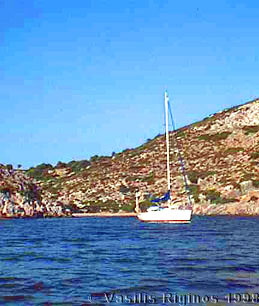
We had the most luxurious showers: hot water plus plenty of running cold water. We went ashore and climbed up the hill to the Megalo Chorio (large village) and later had supper with beer and appetizers followed by grilled fish at the little Glaros restaurant at the water front. The fish was fresh and delicious.
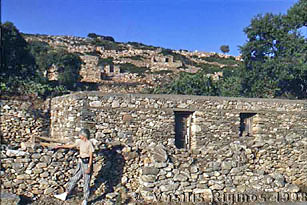
Friday June 26, 1998 Day 16
This is our last day on Thetis before moving to our house in Kalami, Samos. At about 7:00 AM a small fishing boat with a young man and a young, foreign looking, woman arrived into our cove and anchored near us. Two young children emerged, speaking Greek and calling the lady “Mama.” They and the man went ashore lit a fire and cooked some fish. They then went back on their boat ate the fish for breakfast, raised their anchor, and left waiving at us.
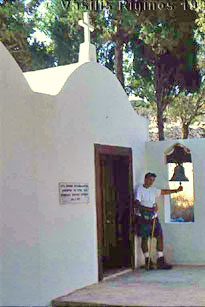
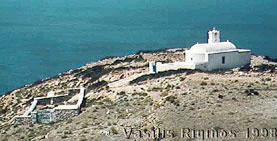
We took a walk up the hill from the cove where we found a little double church dedicated to Ayios Ioannis Prodromos (Saint John the Baptist) and to Ayia Irene (Saint Irena). It was very cute and freshly white washed. On our way there we met a Swiss gentleman whose boat we had seen last night at the Agathonisi harbor. It is a large ketch-rigged caïque. She was made in Malta! He travels every year between Greece, Turkey, Italy, and Malta.
We had lunch under our tent and packed our clothes. After a last swim in the crystal clear but very cold water we untied the line, raised our anchor and left at 1445. The wind was variable from the NW gusting up to 27 knots and going down to 12. We motored around the SE tip of the island, then unrolled the genoa and sailed while keeping up the tent. When we were about 4 M from Samos the wind changed direction and became contrary and we were forced to start the engine. The engine tachometer stopped working. We arrived in Poseidonio [37° 42.65' N 27° 03.3' E], Samos at 1840, distance covered 17.8 M.
We anchored temporarily while we prepared a cavos (line) whose one end we tied to an underwater permanent mooring and the other to a fender. We then re-anchored with 50 m chain and 20 m rope and backed up to the fender, grabbing it with the hook. We then tied the cavos, adjusted both cavos and anchor line. The whole operation took about one hour.
We have arrived at Samos! The trip is over. We have traveled 234.6 M since we left Glyfada, for 44 hours.
We visited with our friends Nikos and Helleni Karapanayioti who watch after Thetis while we are gone. Later we went ashore to our friend at the Kerkezos restaurant who also keeps an eye on our boat while we are in Kalami. There was a large “mega yacht” anchored further out on the cove. We were informed that it belongs to the “Metaxas,” whoever he is.
Saturday June 27, 1998 Day 17
We finished packing and by 9:00 we were ashore with all our bags ready for the taxi, driven by our friend Dimitris Tsesmelis, to take us to Kalami.